
5 Trained Behaviors We Use Daily
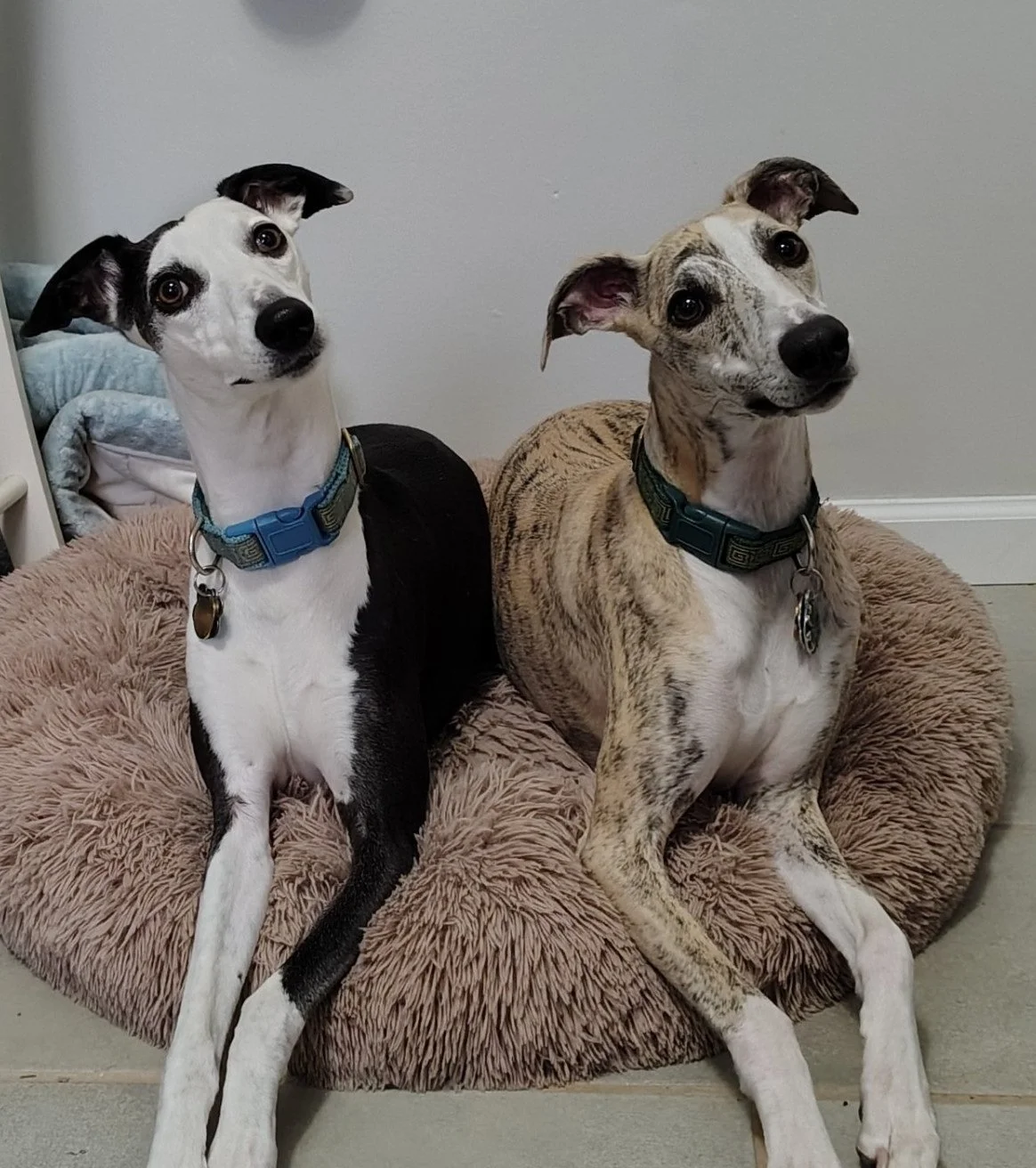
My two whippets waiting on their bed for dental bones.
Last week I talked about why I train my dogs and what I love about dog training. I talked a lot about the whole magical bonding experience of it all -- but this week we’re going more practical. I’m going to talk a little bit about some of the training I use all the time with my dogs, just to reduce friction in our everyday life.
These are 5 trained behaviors we use on a daily basis:
1. Go to Your Mat (“Place”)
This is where you send a dog to a “place” – whether it’s a bed or a mat or a platform or whatever you’d like. I use this one multiple times a day. For example I have a mat for the dogs in my kitchen that I can send them to if they’re getting underfoot during food prep. (Note that I could just use management to keep them out of the kitchen with our gate, but I actually don’t mind having them around me while I’m in there -- I just don’t want them right under my feet.)
Every morning I ask the dogs to go to their mat in order to get their morning dental bones – this is an example of something super simple you can build into your routine that will help keep that behavior strong.
I will also send the dogs to a mat or bed so I can put on their walking gear without them bouncing all around me (looking at you, Florence). And I will also use this just whenever I need them to get out from under my feet! I have whippets, and they typically really like to be right up next to you at all times. So being able to send them off to go lie down for a bit is a great option to have for when I do need them to give me a little space -- so I can clean, or exercise, or do whatever it is I need to do without help from two nosy whippets.
2. Hand Target
If you’ve ever worked with me on foundation skills, we’ve definitely trained a hand target. This behavior is very simple: your dog touches her nose to your hand. A hand target is one of my all-time favorite behaviors because it is so useful in so many situations. It can work as a recall, to move your dog from place to place, to help with loose-leash walking, as a way to get your dog past distractions… There are so many ways to use a well-trained hand target. For some dogs it can even be a confidence-building behavior. It’s also usually fairly easy for most dogs to get, and so it can be a really effective way to introduce a dog to clicker training. I love this behavior for my greyhound clients especially because most greyhounds seem to really enjoy it once they get it!
I use this daily to help Florence keep up her loose-leash walking skills, as a recall, to move my dogs from place to place, to help my dogs get past distractions on walks, and just for fun. For example if we’ve struggled through a training session for whatever reason, but I want to end on a good note, I might ask for a couple of hand targets just to end on something easy and fun for my dogs. Because it’s such a simple behavior that doesn’t require a ton of concentration from the dog, it's also one of my go-tos when I’m checking to see if my dogs are able to focus in a new environment.
3. “Close” & “Side”
These are the cues I use for “go be at my right side” vs “go be at my left side.” This has saved me from tripping over dogs or leashes many times, and makes it a lot easier to maneuver around the world with two dogs.
For the most part, our regular walks are opportunities for my dogs to sniff and wander a bit and experience the world. I don’t typically ask my dogs to maintain even a loose heel very often unless we are either actively training, or for some reason it’s necessary (we’re in a crowded space or walking around a dog-friendly store, for example). But some of the time I need the dogs to come be at one side or another – like when they’re standing directly in the way of the gate I’m trying to open, or maybe someone is coming up alongside of us on a path and we need to move over. In these instances it’s invaluable to have cues that mean “go be at my left” and “go be at my right.”
4. “This Way”
On a similar note, “this way” to my dogs means, essentially, “come follow me.” When we’re walking (especially with our 10ft leashes) this is so important to be able to avoid pulling on the leash when changing direction, and instead simply tell the dogs “we’re turning now; follow me.” We usually use this at least a few times per walk. I also use this on off-leash walks -- and as with all our loose-leash walking skills, we first trained it indoors, off-leash.
5. Waiting at an Open Door
This one touches more on the safety side of things. I’ve taught both my dogs to wait and remain still when a door is open. This allows me to do things like bring out unwieldy cardboard boxes to the recycling, or bring in shopping bags without worrying that my dogs are going to bolt outside just because I’m not blocking the doorway with my body the entire time. I think this is a really important skill for just about every dog to have -- and like everything on this list, it can be trained entirely with clicker training.
These are just some of the practical behaviors we use every day in our home to help us all live together more harmoniously. Every household is different and has different priorities, so your 5 most-used behaviors might not be any of these! But I think they’re great examples of how good training helps you communicate better with your dog and be more in tune overall.