

4 ways I prepare for better dog training sessions
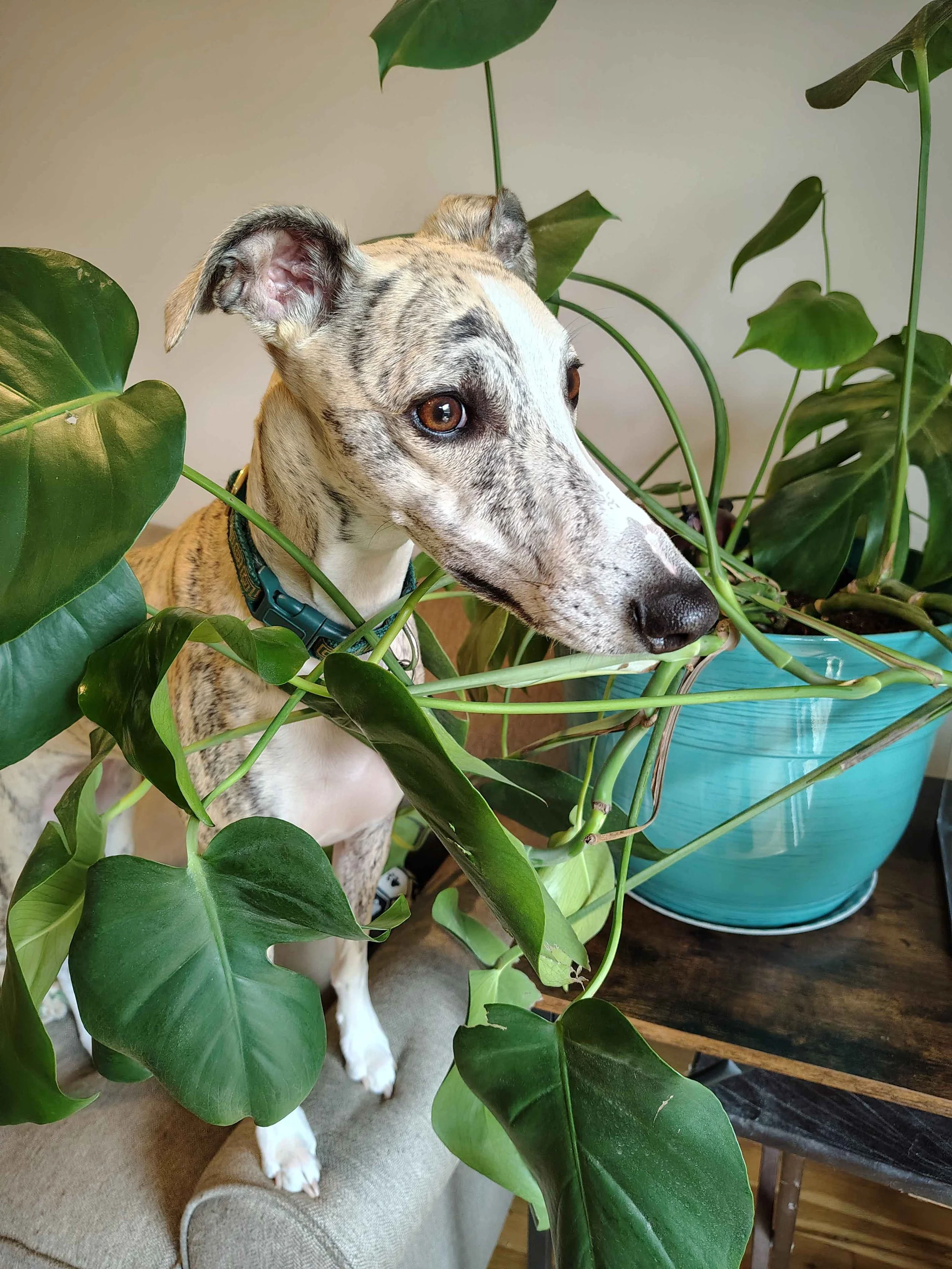
This is not an ideal training set up, as Florence is being consumed by a monstera plant.
Previously we talked about the 5 trained behaviors I use with my dogs daily – but how do I get those behaviors? Well, first let’s back up, because I believe a good training session starts with good preparation.
I won’t lie – sometimes I train my dogs messily, on the fly, with little preparation going into it. But when I’m working on something brand new or complex, there are certain ways I prepare my environment and myself to make sure we get the most out of our training sessions:
1. I check in with myself, and I make sure I’m physically and emotionally ready to train.
I don’t start a training session when I’m really frustrated or angry about something and my temper is short. (I may take some deep breaths and then train when I feel better, but I don’t go into a session in that state.) I also don’t start a training session when I’m dead tired and can’t focus. It’s not fair to me, and it’s not fair to the dog.
2. I create my training sanctuary.
Once I’ve checked in with myself and made sure I’m in a good state to train, I make sure my training space is quiet and free of distractions. Distractions can look like music playing, foot traffic coming through the room, the window being open on a nice day when all the kids in the neighborhood are outside, dog toys being scattered out across the floor – anything that’s going to make it difficult for my dog (or me!) to focus on the training. (Later on, we can actually build distractions in to our training environment to make the behavior stronger, but when we’re doing something new or complex we do not want to make it any harder.)
The way I physically set up my space depends on what we’re going to be training. If I’m going to be clicker training my dog to go to a mat, I don’t really want any toys around on the floor. Besides being distracting, it can be confusing to the dog, especially if they have any trained behaviors involving toys. For example, if I am training something new with my dog Evelyn but there is a toy at her feet, we may have an issue. She may default to picking up the toy in her mouth because that’s a behavior she knows well, and one she expects me to ask for. (Evelyn is the kind of dog who anticipates cues and tries to read my mind.)
Something to also consider in your training space is the flooring. You may have trouble with certain behaviors (such as a spin) on slippery floors; it may help to put down a rug or even some yoga mats. And it’s not going to be easy to teach most sighthounds to do a down on a hard wood floor, so you may need to reconsider where you’re working or grab something for cushioning.
I also have two dogs, both of whom really want to be the one training. We have worked on stationing (where one dog waits her turn while the other trains), and sometimes we do this. But I often will simply give the dog who is not being trained some kind of enrichment toy to enjoy while I work with the other dog.
3. I prepare my supplies.
This usually looks like:
filling my treat pouch with a ton of really tasty, bite-sized treats before I buckle it on
grabbing my clicker and looping it around my wrist
getting ready any miscellaneous items we may be using (mat, training dumbbell, box, sticky notes for targeting, leash, paw targets, et cetera).
and finally, setting up my phone camera and tripod to film my session.
Some additional notes on these:
When I fill my treat pouch, I always stuff it with more treats than I think I will need. Sometimes when we’re training indoors in a low-distraction space I just use kibble — it depends on what behavior we’re working on. Usually for the more challenging stuff you want higher value treats; something really stinky and delicious that will be extra motivating for your dog.
I do use a clicker more often than not. I really find it increases precision and my dogs learn faster with it.
For miscellaneous items, I want to have these ready to go as soon as the training session begins. I don’t want to be fumbling around for things and leaving my dog waiting — and potentially disengaging.
As for the camera, I cannot recommend filming your training sessions enough! It really helps so much to watch back and notice your body language and your dog’s body language; there’s a lot we can’t see in the moment. Watching back my sessions genuinely improves my training and helps me when I get stuck on something.
4. I have at least a loose plan going in.
Sometimes I actually have a written training plan, but I pretty much always go into a formal training session with at least a loose idea of what we’re going to do. By this I mean, I know the bare tiny basics we’re going to start out with, I know what the ultimate goal behavior should look like, and I have at least a general idea of what the steps toward the ultimate goal behavior might look like. If we’re talking clicker training, I know going into my session what behaviors I’m going to click and treat.
Of course, my dogs may do (and often do) something totally unexpected, and in that case it’s important to be able to be flexible and adapt on the fly – maybe even throw the whole plan away if necessary. After all we’re not putting together furniture here, we’re working with living beings with their own beautiful brains and ideas about things.
I think a good training session for me and my dogs looks like a combination of good preparation and a strong training plan – AND lots of adaptability and flexibility. Sure, the dog in your structured training plan does one thing, but the living, breathing dog in front of you may do another thing entirely! (And don’t we love them for keeping life interesting.)
Next week I’ll talk a little bit about how I make the most of my sessions while we are actually training! ’Till then, enjoy your dog.