
The Stay & Go Game
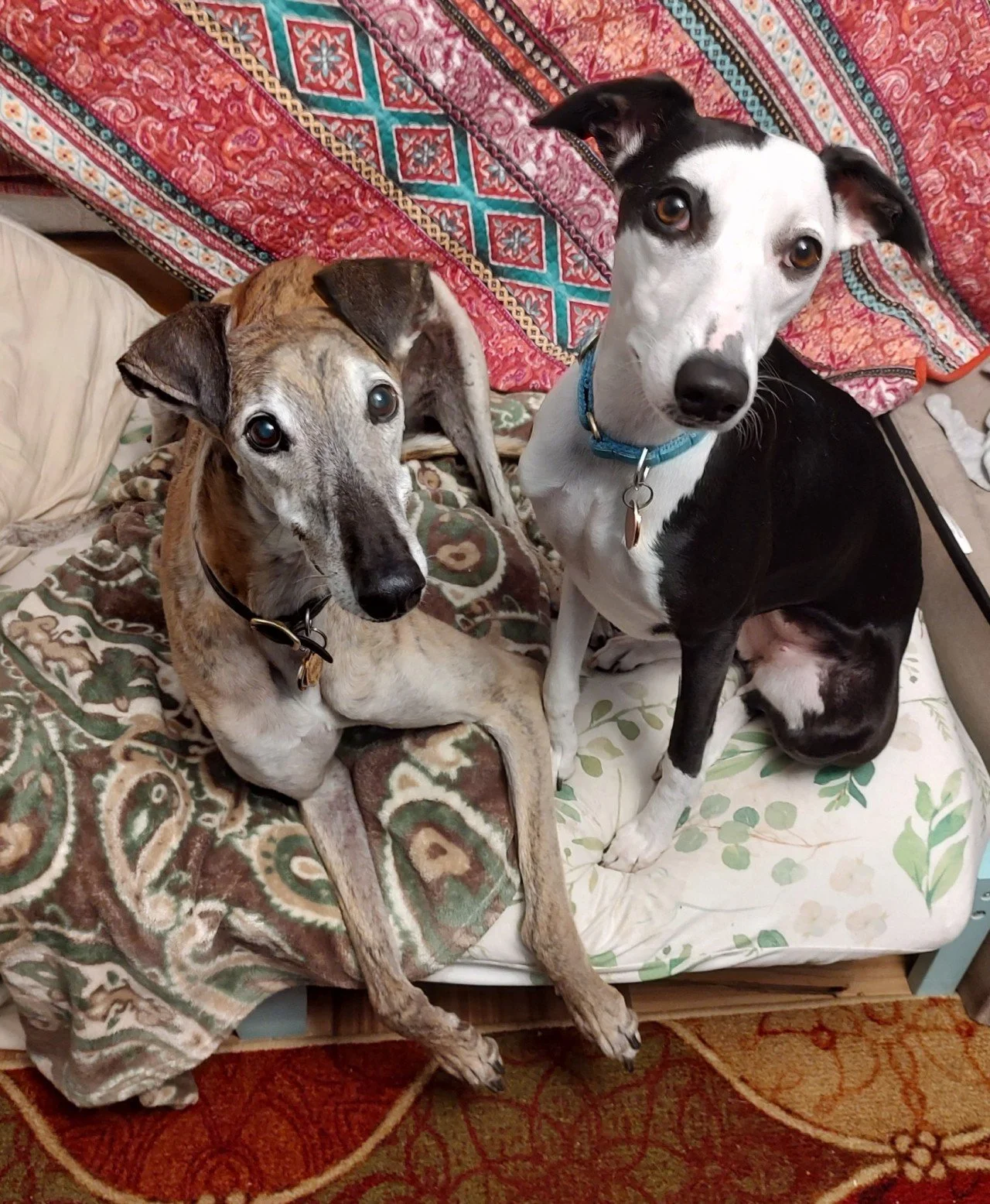
My late greyhound, Hazel, and my whippet Evelyn practicing the Stay part of Stay & Go.
Right now here in New Jersey, it’s absolutely boiling outside. The sidewalks and pavement are way too scorching hot for little paws, and not to be dramatic, but it genuinely feels like the sun wants to murder us. So, I’m doing a lot of indoor activities with the dogs until this heat wave breaks.
I thought I would share with you a little training game I like to play with my dogs when the weather outside is less than cooperative. It’s very simple, but it’s a way to engage your dog mentally and physically without too much effort on your part at all. I’m going to go ahead and call it the Stay & Go Game.
For this game, your dog needs to have some concept of a recall (coming when called) and some concept of a stay (remaining stationary in position on cue). But if your dog doesn’t have those things perfectly down, you can also use this game to help strengthen each concept.
How it works:
Stuff your pockets or treat pouch with a whole bunch of small, tasty treats.
Now put your dog into a stay, ideally somewhere it will be extra easy for them to hold that stay. A dog bed or the couch is a good option. It doesn’t matter what position they are in as long as they’re able to easily and comfortably maintain a stay in that position. When you give your stay cue (“stay” or “wait” or whatever cue you prefer), you want to only say it once.
You then take a few steps away. Wait a beat. Then call your dog to you! Use a light, happy voice.
When your dog comes to you, reward and praise heavily.
Mix it up: throw in some repetitions where you do not call your dog. Simply ask for the stay, take a few steps away, walk back to your dog, and mark and reward the dog for holding the stay. This helps prevent your dog from anticipating the recall and breaking their stay preemptively.
Rinse and repeat, increasing how many steps you take away each time, until you are calling your dog from across the room or even across your home (be sure there are no trip hazards for your dog; they may come to you at high speeds).
As you keep playing, remember to continue to mix it up and periodically just reward holding the stay.
Be sensitive to your dog’s body language and end the game on a good note if they seem to be getting tired.
If it’s really hard for your dog to hold the stay:
First concentrate on only rewarding the stay itself. Ask your dog to stay, take a few steps back, return to your dog and then mark and reward. Repeat this 3-5 times, increasing the amount of steps you take slowly.
Then you can return to going back and forth between rewarding just plain stays, and doing the full Stay & Gos. If your dog struggles to stay at any point, decrease the distance and again, work on maintaining and rewarding the stay. This work alone can be mentally tiring for your dog, so it’s still a good use of indoor time.
If it’s really easy for your dog to hold the stay:
Try having your dog stay at further and further distances.
Have your dog stay just around a corner so they can’t fully see you.
Then build to having your dog be in another room so they can’t see you at all. Walk a few steps outside of the room and see if they can wait a beat until they hear their recall cue. Increase the distance you walk away each time.
Remember to mix it up and sometimes return the dog and reward the stay itself.
If at any point your dog struggles, go back to an earlier step.
If you’re in a small space and can’t increase distance very much:
Focus on duration and distractions instead!
Duration: How long can your dog maintain that stay before you call them? 1 second? 5 seconds? 15 seconds? Remember, if your dog struggles at any point, go back a step and decrease the duration.
Distractions: Can your dog maintain that stay even if you stand on one foot? What if you put a toy on the floor nearby? What if you have someone else walk past while you are asking for the stay? Start with very simple, small distractions (a less-beloved toy placed on the floor at a good distance from the dog, very small movement from you such as lifting one foot) and then you can slowly try adding in bigger ones.
Only work on one of these pieces (duration OR distractions) at a time.
And that’s really just about it! The Stay & Go Game is super low-effort for the human while also helping to sharpen your dog’s skills and give them something fun to do when the sidewalks are lava (or covered in ice, or flooded, or whatever weather conditions are keeping you stuck indoors).
It’s the kind of game you can adapt to your dog’s skill level and needs too. Maybe you have a dog who’s still learning to hold a stay when you take two steps back, or maybe you have a dog who can be a motionless statue three rooms away from you till the end of time. Either dog can benefit from Stay & Go.
If your dog surprises you – either by nailing this game or by hitting a wall you can’t quite work through – I’d love to hear about it. Troubleshooting training is what I do, so don’t hesitate to reach out if you get stuck.